


The temperature at which paper burns 451°F

By four o’clock the day is already slipping away when I leave school and the sky is red along the horizon, smoke held in the cold air like a breath no one lets go. I think of fire, of firemen who burn houses, books, ideas. No one shouts. No one protests. Somewhere there is only a whisper, thin as a page, carrying a book out of the blaze.
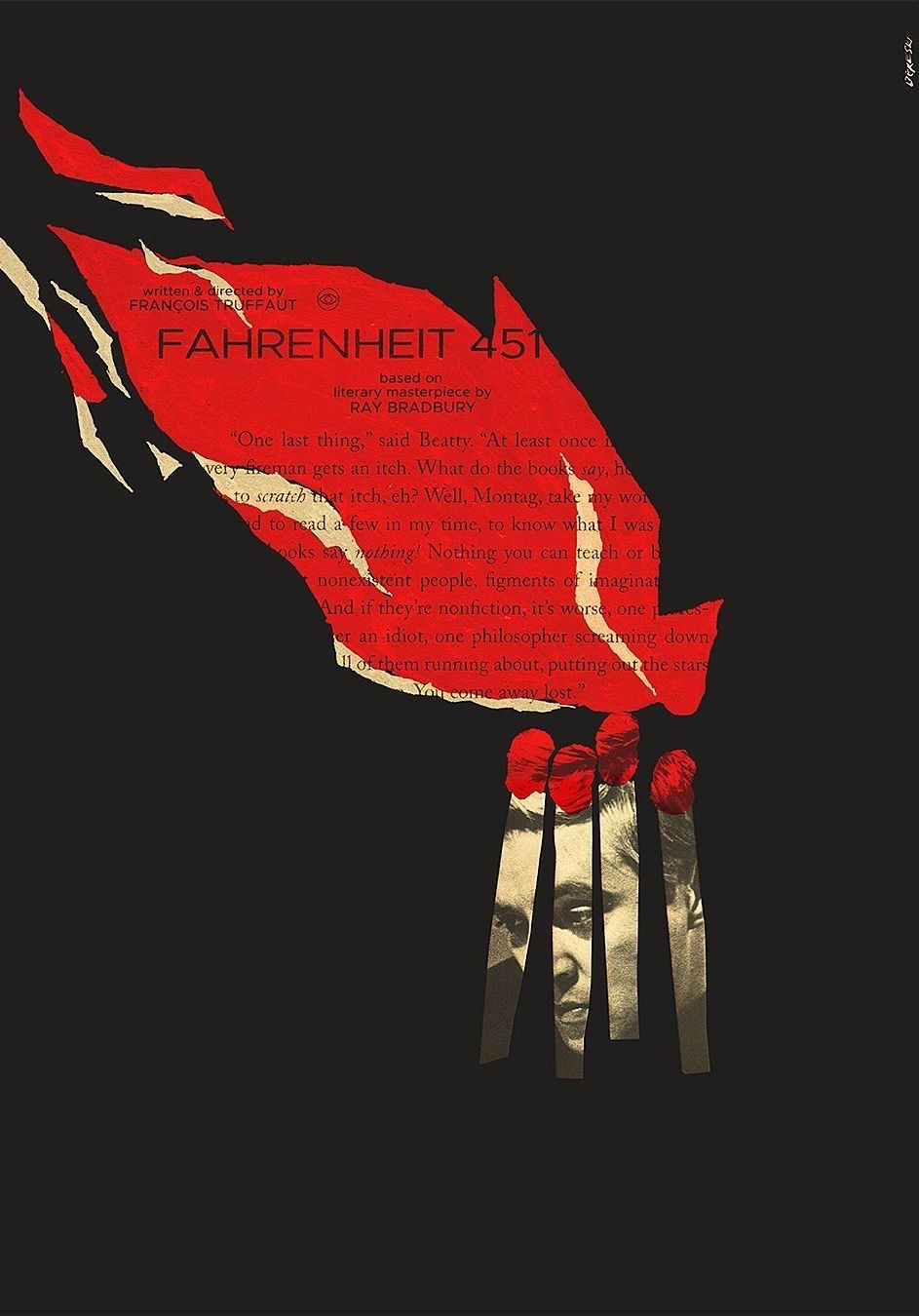
I read “Fahrenheit 451” in November. It’s a small excuse for a theme, maybe, but the world outside matched the pages inside. The colours of autumn looked like fire; the chimneys smoked; by the time I left school, it was already dark like Montag walking home after work, talking to Clarisse in the night air. November is when things go quiet and doubts get louder. We feel less certain, less happy (At least I do). “Fahrenheit 451” belongs here because it is a book of doubt and thinking: a whisper asking whether our warmth comes from a lightbulb, or from something quietly burning that we never questioned.
“The autumn leaves blew over the moonlit pavement in such a way as to make the girl who was moving there seem fixed to a sliding walk, letting the motion of the wind and the leaves carry her forward. Her head was half bent to watch her shoes stir the circling leaves.” (Bradbury)
“Are you happy?” Clarisse’s small question cracks Montag’s world in “Fahrenheit 451”, and then it sits with us too. Happiness is one of the hardest things to name. Are we ever sure we have it? Should it come from outside (grades, likes, praise) or from somewhere less visible?
Last week in a bakery, a four-year-old sat next to me with an ice cream, legs swinging. I caught myself wondering: is he happy right now? Maybe happiness is sometimes nothing more (and nothing less) than that small, melting present tense. That was how my mother left me at the café: sitting there with my questions, between cakes and sugar. And that’s when it struck me that Bradbury warns how easily we confuse numbness with joy, comfort with meaning.
Montag realises he has been wearing his happiness like a mask. Then someone appears and, simply by asking, pulls it off. You can’t knock on a door and ask for your old illusions back. You see yourself clearly once, and the mask stops fitting.
Someone once told me that as you grow older, your conscience starts keeping you awake. At night you lie there, weighing your choices against the small child inside you, checking whether you’ve betrayed them. You ask yourself: which mask makes me me? Which masks did I wear today, and did they make me happy? You want to send the exploding head emoji, but there is no one to send it to. So, you become both the sender and the receiver of the unknown. Guy Montag’s desperation in “Fahrenheit 451” stems from a belief that books contain a definitive knowledge he lacks, a cure for the ignorance that plagues his hollow life. This is where Umberto Eco's idea returns to me: that our unread books define us. They mark the limits of our knowledge and the vast landscape of our ignorance. The more we learn, the longer the shelves of unread books become.

“This book has pores, it has its own characteristic features; you can put it under a microscope and find in it life, flowing beneath the framework in endless abundance. The more such pores there are, the more lines of recorded details of life fit into every square inch of paper, the more “literary” the work becomes. That is, at any rate, the definition I have coined for my own use. What counts are the details. The trifles.Fresh details. Good writers often touch life; average ones skim along its surface, and the weak violate it and abandon it to the flies.”(Bradbury)
Books don’t burn at 451°F because they are made of paper; they burn at 451°F because they are made of life. They teach you to read in low light, to tell warmth from burning, to hear the quiet whisper under the sirens. That is Bradbury’s real power: the kind of story that makes you rethink your week, that makes a teacher forget a student who is writing a test as they walk out at the red November sky, wondering what they are doing with their life.
Why do we read books that no one forces us to open? What makes us sit down, in the middle of a busy day, and “waste” time on pages full of tiny black letters?

“Then what’s the point of reading at all? " he asked, starting to write. […] It may not be easy, but that doesn’t mean it’s impossible. Of course, someone who’s sensitive enough to look within can change a little thanks to even a single book. But I believe that even those who lack that ability, under the constant influence of what acts on them, will eventually have no choice but to take an honest look at themselves.””(Hwang Bo-Reum, Welcome to the Hyunam-Dong Bookshop)
“We don't read and write poetry because it's cute. We read and write poetry because we are members of the human race. And the human race is filled with passion. And medicine, law, business, engineering, these are noble pursuits and necessary to sustain life. But poetry, beauty, romance, love, these are what we stay alive for.” (N.H. Kleinbaum, Dead Poets Society)
Books are dangerous “weapons,” because they can make you think differently, rise above the average. In the book "Fahrenheit 451” Captain Beatty, the fire chief, explains that burning books didn't start with a tyrannical government but began with the people choosing comfort. Books started to shrink as people began reading summaries; they began shortening everything. "From the nursery to the university and back to the nursery. That is the pattern of intellectual development that has been in place for at least the last 50 years," he states. Life became fast: work, and after work, pleasure. The mind absorbed less and less. Beatty argues that when everyone is the same, no one has to feel small. If no one rises above, no one feels inferior.
“In the end everyone became equal. Each of us is a reflection of all the others, and then everyone is happy, because there is no peak to look up to and feel small before. A book, in fact, became a loaded weapon; so don’t let it lie around in the house. Burn it. Fire it from the gun. Smash it. You never know who might become a well-read person. As for me, I sincerely hate books. And that is why, once all houses were finally made fireproof and the old firemen were no longer needed, they were given a new job: to guard our peace of mind. In them is focused our rightful and understandable fear of being inferior. They are our official censors, judges, and executioners. That’s you, Montag. That’s me.”(Bradbury)
So the firemen are given a new role: not to save houses from fire, but to protect society from discomfort, doubt, and complexity. Beatty himself is more tormented than Montag, precisely because he is well-read. He knows what has been lost. He understands too much to be truly numb, but chooses to weaponise his knowledge instead of acting on it. That tension between knowing and obeying is his private hell.
So what is the point of reading? To resist being flattened. To keep the parts of us that still feel, argue, doubt, and dream from quietly burning out.
Later, the image of the phoenix appears in the novel: humanity burning itself over and over again, always rising, always forgetting. Unlike the mythical bird, we have records, books, memories of our own stupidity. If we chose to learn from them, maybe we would stop building bonfires and jumping in.
“A long time ago, before Christ, there was this foolish bird. Phoenix, that was its name. Every few hundred years it would build itself a funeral pyre and burn on it; must have been a close relative of man. Only every time, after it burned, it rose again from the ashes, brand new. It looks as though we keep doing the same thing it did, over and over; except we’ve got something that damned Phoenix never had: we know what stupid things we’ve just done, we know all the stupid things we’ve been doing these last four or five thousand years. If we don’t forget them and don’t go on repeating them, if we actually learn something, then one day we’ll stop building huge bonfires all over the world and jumping right into the middle of them. And there will always be more of those who remember.”
Will history stop repeating itself?
There is another whisper in the background: “We didn't start the fire. It was always burning, since the world's been turning. We didn't start the fire. But when we are gone. It will still burn on and on and on…” Every generation inherits problems left by the previous ones, and we are the ones who must decide whether to fight them or pretend not to see the flames. The question Bradbury leaves us with is this: will we keep feeding the fire of ignorance and comfort, or will we finally choose to read, remember, and protect the things that keep us human?
Maybe that is why November feels like the right month for these doubts: the world is going out in slow motion, leaves burning out into brown and gold, the air full of smoke and unfinished stories. It is a month that whispers, not shouts. A pause long enough to decide whether to stare at the flames or to reach for a book. Opening a novel, a poem, or even a short story about a tiny bookshop is a small act of rebellion against forgetting: a decision to carry memory instead of ashes, to sit with discomfort instead of sedation, to stay vulnerable, stubbornly human.
Page design: Asya Chub
Bibliography
Bradbury, Ray. Fahrenheit 451. Ballantine Books, 1953.
Hwang, Bo-Reum. Welcome to the Hyunam-dong Bookshop, Bloomsbury, 2023.
Dead Poets Society. Peter Weir. Touchstone Pictures, 1989.
Photos:
brandenvondrak.com, Fahrenheit 451 Illustration , https://www.brandenvondrak.com/Fahrenheit-451-Illustration Acessed 24 Nov. 2025
Into the Night: 12 of the Best Books to Read in November, https://zoomer.com/zed-book-club/bookshelf/2025/10/30/into-the-night-12-best-books-to-read-in-november, Accessed 24th Nov. 2025
Pinterest, carmen laura, Fahrenheit 451 (1966),https://i.pinimg.com/1200x/73/b5/cc/73b5cc5c5024e415dd22862962243279.jpg, Accessed 24 Nov. 2025


Comments